Tuesday, March 22, 2016

Has Anybody Made a "Suppressive Person" T-shirt On Cafe Press?: On Alex Gibney's "Going Clear" & Fiona Maazel's "Woke Up Lonely"


Joe and I watched the documentary Going Clear: Scientology and the Prison of Belief about Scientology, and of course the first thing out of my mouth afterwards was, "How much do you want to bet if we went on the internet right now we'd see somebody has made a "Suppressive Person" t-shirt on Cafe Press?" Sure enough, there it was. As usual, because I'm a total shallow asshole the actual message of the movie -- how dangerous a powerfully financed cult can be against individuals, groups and the government -- was secondary to my preoccupation with Scientology's place in popular culture. So although I might be accused of lacking a certain empathetic humanity, I'd certainly never be accused for lack of discerning taste in clothing; Cafe Press didn't have quite the style I was looking for so I convinced Joe that we should design our own t-shirts, and that's exactly what we did at the T-Shirt Deli down the street. The front of mine says "Suppressive Person" (in yellow "mini cooper" lettering), and the back says "Potential Trouble Source," while Joe's is in reverse. And they're printed on a Scientology blue shirt, which, I should mention, is also the color of the Freemasons (aka the Blue Lodge), not that I'm drawing any similarities, but I do think that's hilarious. These shirts were our valentine's gift to each other. In a hilarious twist of coincidence, blue is also the color of the Blue Ribbon Glee Club, the a capella punk rock glee club we sing in. Joe and I have taken to wearing these shirts when we perform, in tribute to the absolutely ludicrous Scientological lite-rock We Stand Tall video featured in the documentary, because again, well, we're assholes.

In Going Clear a few people talked about joining because they wanted to learn about some of the things Scientology claimed to help someone do, but it seemed like a fair amount of people joined because actually, they were lonely. A number of ex-members talked about how much they enjoyed the social aspect of the "auditing" interviews "clearing them," and they often talked about auditing sessions as moments where they felt as though they were bonding with their auditors, making it very social. Also, they talked about auditing being like therapy for them that could, as religion researcher Hugh B. Urban phrased it (as cited on Wikipedia here), "trigger personal insights, and cause dramatic changes in one's psychological state. The recalling and expression of old hurts in response to the auditor's questions may [have] feel like an unburdening."

Interestingly, around the same time I saw this movie I finished reading Fiona Mazel's novel Woke Up Lonely (Graywolf Press). It's about his guy who starts a Scientology-ish cult called the Helix that promises to eradicate loneliness. (Strangely, I recently ran into the imagery of the helix in the movie Her that I finally watched from a few years ago about falling in love with or becoming BFFs with a computer operating system as an AI in all its Singularity glory, which I LOVE, LOVE, LOVED. I think the helix was like, the icon of the company that made the OS, if I recall, but weirdly and poetically, the internet is NOT helping me confirm. What I have not watched: that show The Helix that was on for 2 seasons.)

In Woke Up Lonely there's all this stuff about the cult founder, who is actually really lonely, and he misses his ex wife and daughter. There are adventures about his ex wife being a spy, some hostages, North Korea, all this other stuff. And oh, a fake fat suit. Can't forget that. Lots of ridiculous disguises and this bizarre, awesome relationship between the ex-wife/spy and the man who does her makeup for her disguises. The ex-wife is tasked by the government to crack down on the cult leader, but she she actually tries to thwart the cracking down; it's kind of a tricky situation. Her relationship between with the make up artist is what I imagine it must be like with performers who do shows over and over, where they see the same artist every day. A relationship develops.

In the book the Helix is a cult (although in true cultish mode, members argued it wasn't) about banishing loneliness. They have functions like speed-dating and confession sessions, and there obvious are Scientology parallels. Everybody knows about the Scientology "auditing" sessions, which is the Scientology version of (sort of) therapy and (sort of) social bonding. Two seconds of searching on the internet told me that I am not the first person to make this parallel in Mazel's book and Scientology, and I have to imagine she was inspired by some amount of research, so it's not like I'm going to make some big revealing analysis. It was just weird that I personally read the book and saw Going Clear around the same time. Is the world trying to tell me something? Am I NOT supposed to be going to potlucks at the Chicago TM center?

I guess I never thought about it until then that maybe the biggest reason someone might join a cult is that of loneliness. I myself, can be lonely at my own birthday party because I have such social anxiety. However, for me personally, me being who I am the main reason I would ever join a cult,  would be if it promised me something otherworldly. I don't want a cult that promises me merely community. I want some mystic action! I want to be promised cosmic wisdom and higher vibrational effervescence! Friends are nice and all but what I would really want is some holistic, inter-dimensional, Terence McKenna fulfillment. And answers! I want some god damn answers! What is time? What is reality? What is consciousness? All that shit.

Weird that these two things would cross my path at the same time. Clearly the universe are trying to tell me something. And that isn't that "Love the people in your life, all that we have in the end, after all is said and done, is love, and that is what sustains us."

Clearly the universe is telling me that Cafe Press makes shitty t-shirts. Hail Xenu.
_______________________________

In case you're curious: some of my favorite quotes from Woke Up Lonely.

I enjoyed the banter in Wake Up Lonely between wry characters. One character, Rita said this and I loved it (p 77):

"You know, most of the radicals in this country are fixated on their commitment to revolution way more than on the revolution itself. They don't want to succeed. because if they did, they couldn't be radicals anymore, and a radical is most interested in his sense of being a radical."
There was some delicately incisive poetics that I kept reading over and over, sort of beautiful crystalized little gems of wisdom, even if in the mind of fictional characters:
"I suspect there's more than one path leading away from estrangement, though for some people, there are no paths at all...There is no lonely course that doesn't still belong to the plexus of human experience being lived every day." -Thurlow, 180-181
"When you grow up neglected by the people you love the most, it tramples your self-esteem, and when you are adult enough to stop blaming them, you end up blaming yourself, which means, wamu! even less self-esteem." p195
"Do we love people for the way they treat us or who they are? Is there a difference?" p200
"In sleep, though, people forget themselves, or come into the selves they've spent most of their lives trying to repress." p206
"They had been happy once. Since then it had been x days, months, years, and she missed him with a degree of agony that would have sent most people running back to him a long time ago. But not Esme. Instead, she had ignored the need, boxed it up, put it away, acquired new experiences to box and pile until her tower had grown nine thousand boxes high and there was no chance she could feel that first box on the bottom, right? Princess and the pea. Such a deranged moral to offer a child. The more sensitive you are to pain welled deep in your psyche, the more noble your spirit? It was better to be noble than happy? She pressed her ear to the wood. And the weeping she hears inside needed no interpretation. It's true that when your subject weeps and so do you, it is hard to tell your hurt form his. For a person who listens, rare are the moments you don't have to." p227 
"At home a sick mom and the burden of caring for this sick mom, which would fall to her alone. That, plus an emotional terrain that smoldered as though after a great fire but that could yield up nothing new, and in this paradox of trauma: the past could live on in you with an energy you could never muster for the life that was happening to you now. And just think: tomorrow, she could be returned to all of that. Unharmed, unchanged." -p249
"What is tolerable in a person you love? Or want to love so much you will tolerate most anything?" -2p69
I got this book as an uncorrected proof from the publisher a million years ago, and it's kind of crazy that I would happen to pull it off the shelf to read it now. Why is that?


Wednesday, February 10, 2016

Unretrieved Rabbits, Zero-Density & The Second Oldest Profession: On Death by Black Hole and Other Cosmic Quandaries


So I said I was going to start using my blog as a place for talking about the books I'm reading and sharing the quotes I enjoy from them, sixteenth century "commonplace book" style. I am not a speed reader but I will say the books are piling up faster than I can get to writing about them. I think it would easier if I was just putting the quotes I like from the books, but I feel like I should be saying something about each quote, or something bigger about each book (and no, not every book has memorable quotes but that doesn't mean it wasn't a good book, like Al Jourgensen's memoir Ministry: The Lost Gospels According to Al Jourgensen, for example.) So then, the book doesn't get mentioned on my blog. But I'm not here to write book reports. If I were smarter and a better writer I would say that I would be writing book criticism, but I feel like a shitty writer writing criticism about a book is really just someone writing a book report. And I don't want to be that person. I feel like what I do is somewhere in-between book reports and book criticism, but it's not really either. (Hey! That's the internet for you. Not quite this, not quite that, somewhat memoir-based and kind of all based on opinion, TOTALLY unofficial and certainly written by someone who has been sitting in one place for too long and should have gotten up to get circulation going HOURS ago.) So I'm not blogging about every book I read, just the ones with quotes that I've liked enough to mark in the margins.

My blogging about books went on the back burner because frankly, in order to get the quotes I want to talk about, I hate having to retype it all or scan it or take a picture of it. It all takes so long and is too much work. Just now I figured out that I could just read quotes into my phone and from there e-mail myself the transcription. I can fix any mistakes the transcription made, and voila! A high maintenance task has become much easier. How did I not figure that out earlier?

All that is to say, although I finished Neil deGrasse Tyson's Death by Black Hole and Other Cosmic Quandaries a while ago I'm finally getting around to blogging about it now. It's a Best of (of sorts) of pieces that originally appeared (in one form or another) in Natural History magazine under the heading "Universe" between 1995-2005. It's interesting and I learned a lot, but I was also extremely entertained, as I knew I would be, based on any time I see, hear or read anything by the author, who is delightful.

I already knew the concept of gravity as Newton's idea of the force that holds objects near each other, and I also knew of gravity in regards to how Einstein moved the concept of gravity up to the next, next level, as in regards to his Theory of Relativity, with all its warps and curves in the fabric of space and time, but I really I loved this discussion of gravity, taken to a very personal level in Death by Black Hole on page 46:
In Einstein's universe, the fabric of space and time warped in the presence of mass. This warping, and the movement of objects in response to it, is what we interpret as the force of gravity. When applied to the cosmos, general relativity allows the space of the universe to expand carrying its constituent galaxies along for the ride. 
A remarkable consequence of this new reality is that the universe looks to all observers in every galaxy as though it expands around them. It's the ultimate illusion of self-importance, where nature fools not only sentient human beings on earth, but all life-forms that have ever lived in all of space and time.
So, so poetic. We all think we are the center of the universe. And we make little ripples that venture out from us, thinking we're making a huge difference in things. Sometimes we make bigger ripples than others. That's kind of a poetic take on the Theory of Relativity. If the Sun disappeared, say if it imploded, it would create a wave in space-time from its implosion, and that wave would push us out of orbit. You know how long it would take the earth to fly away from our orbit if the sun imploded? 8 minutes. It takes 8 minutes for light from the sun to reach us, which is also how long it would take the wave from the dip in space-time from when the sun imploded. Hope you packed an emergency overnight bag to be ready to leave our orbit so you can be ready in less than 8 minutes! I guess it wouldn't just be an overnight bag you'd need, because it will be all night all the time, being that there's no sun.

And why would the sun be imploding? I don't know. Ask Newton. The whole "sun disappearing" thing which throws planets out of their orbits was his idea.
----
I enjoyed the playful sense of humor in Death by Black Hole:

"By the way, were we to find life-forms on Venus, we would probably call them them Venutians, just as people from Mars would be Martians. But according to the rules of Latin genitives, to be "of Venus" ought to make you a Venereal. Unfortunately, medical doctors reached that word before astronomers did. Can't blame them, I suppose. Venereal disease long predates astronomy, which itself stands as only the second oldest profession." (pg 80-81)

&

"As a child, I knew that night, with the lights out, infrared vision would discover monsters hiding in the bedroom closet only if they were warm-blooded. But everybody knows that your average bedroom monster is reptilian and cold-blooded. Infrared vision with thus miss a bedroom monster completely because it would simply blend in with the walls and the door." (pg 157)

Yesssssssssssss. Bedroom monsters are totes reptilian and cold-blooded.

Also, I love this bit. The "unretrieved rabbits" sounds like something out of The Hitchhiker's Guide to the Galaxy:

"Among those who dabble in metaphysics, some hypothesize that outside the universe, where there is no space, there is no nothing. We might call this hypothetical, zero-density place, nothing-nothing, except that we are certain to find multitudes of unretrieved rabbits." (143)

I have often thought about this. What is beyond where the universe ends? Whenever I think about this I work myself into a giddy lather of anxiety that is also a sort of pleasurable numinousness that I can't quite explain with words but that I can FEEL MY EYES DILATE the minute the topic comes up.

To add to this, I wonder if right outside our dimension but then not quite into the nothing-nothing zero-density place, is there a never-neverland where stuff we've mysteriously lost goes to? Tools, marbles, office supplies, the coffee punch card where I'm eligible for the free latte from filling the card up. (Yes, I looked under the fucking couch cushions, I'm not an idiot.)

I learned some other interesting stuff from this book. 
*The universe is actually "a light shade of beige, or perhaps, a cosmic latte" based on a survey of visible light from the spectrum of 200,000 galaxies.
*Jupiter's moon Io is the most geographically active place in our solar system. It has volcanoes, surface fissures, and plate tectonics!
*The colors on images from the Hubble telescope have been adjusted to show the types of light the human eye can't see, but they are the actual colors. Hubble photos are three composite images, and they generate a color picture that resembles "what you would see if the iris in your eyes ball were 94 inches in diameter" (166).  On the next page, he writes: "I maintain, however, that if your retina were tunable to narrow-band light, then you would see just what the Hubble sees. I further maintain that my 'if' in the previous sentence is no more contrived than the 'if' in 'If your eyes were the size of large telescopes." (p 167) It got me going on a hell of Hubble Google wormhole (there's a joke in there somewhere, something about wormholes obviously):


"With or without warp drives, the long-term fate of the cosmos cannot be postponed or avoided. No matter where you hide, you will be part of a universe that inexorably marches toward a peculiar of oblivion. The latest and best evidence available on the space density of matter and energy and the expansion rate of the universe suggest that we are on a one-way trip: the collective gravity of everything in the universe is insufficient to halt and reverse the cosmic expansion." (266)

For some reason this reminds me how characters in Battlestar Galactica would say things like "All of this has happened before. And all of this will happen again." I was going to say that it was mostly the Cylons that say it but I went to remind myself of the quote and found a slide from a lecture with a list of who says the quote, which reminded both humans and Cylons say variations of it:

Session slide from
Rob Jewitt's Level 3 lecture
Battlestar Galactica: Visions of Trauma and Terror in Sci-Fi Post-9/11
at the University of Sunderland
If only the humans and the Cylons could remember how much they had in common! CAN'T WE JUST GET ALONG? No? OK, well, the Singularity is here and the machines are taking over. How much worse can that be than the sun suddenly up and disappearing?

What if the universe stopped expanding and then imploded and then there was another Big Bang, and this just kept happening over and over, a totally different type of singularity, BTW? We think of the universe as having a definitive beginning and ending but what if was just constantly inflating and deflating? Better yet, what if there was some kind of force that acted as some kind of cosmic bellows that inflated it and deflated it? What if there was a god and it was bellows? Yes, god is an air bag. An air bag that blows air into a fire! Air bag made in his image. The jokes you could come up with, riffing on this.

DeGrasse Tyson additionally writes: "The short list of corpses may sound familiar: black holes neutron stars (pulsars), and white dwarfs are each a dead end on the evolutionary tree of stars. But what they each have in common is an eternal lock on the material of cosmic construction. In other words, if stars burn out and no new ones are formed to replace them, then the universe will eventually contain no living stars." (267)

Well and so there's that. That explains why all these stars have been dying. No more Bowie, no more Lemmy. Wow, the universe really is ending.

But I will keep this quote  from pg 222 in mind:

"Yes, not only humans but also every other organism in the cosmos, as well as the planets or moons on which they thrive, would not exist but for the wreckage of spent stars. So you are made of detritus. Get over it. Or better yet, celebrate it. After all, what nobler thought can one cherish than that the universe lives within us all?"

Oh the coolest!

Monday, January 11, 2016

An Unlimited Adventure

Did I tell you about the weirdo bookstore I went to out in the middle of nowhere? We (me and the husband) had been talking about going there forever and ever, and because we don't have a lot of money, our vacations are day trips or exploring things in our own town that we've never done.

So we took a day trip to the Adventures Unlimited Bookstore in Kempton, Illinois, which is also the Headquarters of the World Explorers Club (where the annual Ancient Mysteries Conferences are held). The bookstore is attached to the publisher Adventures Unlimited.  They publish a lot of the awesome weirdo outer-limits and conspiracy books: Anti-gravity crafts, cryptozoology, ancient Egyptian astronauts, aliens and secret societies, Atlantis, all that stuff. The store was all I wanted it to be and more.

When we got there some of the lights were off when we walked in and it wasn't until a few minutes in that the woman working was all, "Oh! Sorry! I should turn more of these lights on!" which was awesome and hilarious and exactly the type of thing I wanted to happen.

I'd always heard it was a cafe also, but the cafe part might not, well, be a cafe anymore. It was more like there was a coffee pot and a few snacks with price tags on them. There was also an additional room that was clearly the office (formally a cafe?). I peeked my head into and I guessed it's where they did the publishing because I saw the computers, stacks of books, paper. I theorized it was where they conspired about the lizard beings from Sirius B who settled on Easter Island who shot Kennedy . You know, Mulder's office.

In addition to all their own Adventures Unlimited titles (might I suggest ordering their free catalog?), the books that they sell were used books mostly, of the mayhemic sort you would expect, like as if Quimby's were a used bookstore. I stocked up with some pretty awesome ones. My favorite was Hollywood and the Supernatural by Sherry Hansen-Steiger and Brad Steiger.


This book is preposterous of course, in the best possible way, like clearly all constructed out of hearsay, grocery store headlines and things everybody knows (Elizabeth Taylor had a feeling her husband would die in a plane crash, AND HE DID! Celebrities hire psychics! Polanski filmed Rosemary's Baby in the same building outside of which John Lennon was shot, DISMISSED AS COINCIDENCE!) But still, I can't get enough of it. What I would love is for someone to do a Hollywood Supernatural Babylon, which this book isn't that, but I'm just saying. It would be awesome if the writer was an angry-queen-like-Kenneth-Anger-equivalent. And the topic would be not just Hollywood gossip but supernatural Hollywood gossip.

But back to this book, my favorite quote is from Gene Roddenberry, on pg 221:

"I don't know how many worlds are going on all at once. All of us may be living in a different world on which we just sort of correspond. We're reaching each other through those dimensions. I think an exciting way to look at things is to consider that the ultimate power, the ultimate particle, the ultimate meaning is thought itself."

I love this idea. Like we're never knowing exactly what someone feels or what it's like to be them exactly  -- the best we can do is try to communicate from the personal islands we all live on, since all of our minds are contained in different containers -- but the fact that consciousness even exists is sort of the ultimate amazing thing (the irony being, of course consciousness thinks it's the most amazing thing in the world; look what's telling itself that -- which is pretty much the joke Emo Phillips told: "I used to think the brain was the most amazing part of the body. Then I thought, well, look what's telling me that.")

Also at this store I bought some random book I found that is clearly a self-published thing of some sort called Navis Caelum, which is about the physics of UFOs.


 Appropriately and hilariously, there is no info about the author other than a listing for the copyright belonging to someone going under the name (as printed in the inside of the title page) "Grey_0011223455677789." (And yes, when this name is Googled, leaves you with the note "Your search - Grey_0011223455677789 - did not match any documents," which is ridiculously X-Files-ian.) There are, of course, web sites listed on this same page: www.naviscaelum.com and www.theshipfromthesky.com, which both forward to an Amazon page for a Kindle e-book (no other formats listed!) called The Physics of UFOs, with a different graphic than the one I held up in the picture above. I'm assuming that's the same book. The author is listed with a shorter name as "Grey_00112234." And when I click on that author's name that's the only book they have and that's the only info about them, that they have this one book. And there are no reviews for the book. But the description of the book is pretty much what this book was about: "In the future space-time bending technology will become the means for travel, how will we use this technology to build spacecraft capable of traveling to distant destinations? If you ever wanted a look into how a UFO might work and how deep space travel will one day be possible, this is a definite read. A highly illustrated non mathematical book, that starts with the work of Galileo and moves through modern physics. Includes a bonus section: The Shape of space."

Another hilarious thing about this book is that the inside of the cover there's some crazy crushed bug skeleton or something, like a butterfly-moth thing:

You can kind of see its wings in the picture.
I'm sure somebody just used the book to capture a bug and slammed it shut and then donated the book to goodwill and it eventually made its way to this bookstore, BUT STILL. Of course I couldn't help but think about the butterfly flapping its wings and chaos theory and all that, because how could you not think of that in the context of the ridiculously mysterious book and this bookstore? It's sort of perfect.

(Also, I should mention I looked up what "Navis Caelum" meant, and the main info that came up is steampunky stuff and constellations.)

The best quote in this book is this one (pg 3):

"I have been asked where I got this knowledge from? Does it matter? If I said I worked in a top secret government lab, that I was given the information by an advanced society, or perhaps it was leaked to me by an unknown source, the credit of the knowledge would only be as good as your belief in that knowledge. In the end, you must be the judge."

WHAT? "Does it matter?"  Um, YES IT FUCKING MATTERS. Is this info from a top secret government lab? Was it leaked by a source? Would somebody who worked for some secret MIB-ish source really going to distribute their info by written word, let alone resort to shitty print-on-demand publishing with shitty pixelated graphics to break the news to the world about alien technology? Might I have have approached this book differently if I actually believed this was from someone who was a primary source of space/time travel technology? Like if I thought a Timelord wrote this I'd get some fucking graph paper and a calculator out and make a trip to Menard's, if you know what I'm saying.

The book starts with explanation of relativity and pertinant science, but the second half is where things really get into the business of different types of UFOs and how they fly. Specifically, this type of travel needs to rely on "shakers," which are devices that move energy between "emitters," which make dark energy. Emitters create a dense beam of R-Gamma radiation which is important in some way that I don't totally understand. Also involved, jot this shit down: stainless steel casing, calabi-yau spheres, and loops that move out without interacting with matter.

The ship I would be most in favor of using for a journey would be a "moving star cruiser," which is the Lincoln Towncars of galactic travel. A rotating ship with acceleration and warp, it also has the ability to glide in such a way that passengers feel no movement. Some gravity up front, less in back, like a reverse space mullet. That's my kind of ride. All in favor of pimping your star cruisers with stickers raise your hands in the ayer. I love that I bought this book at this dusty weird store, that when I research the title and the author later, I find them to be a big mystery (with a yahoo e-mail address!). P.S.: The internet was made for research like this.

Also at this bookstore I got Carl Sagan's Dragons of Eden and 2 awesome pulpy old magazines:

I can't get enough of the graphics in them:


Of course the bookstore where I got all of this stuff was in the middle of rural Illinois where, appropriately, our Maps function on our smart phones stopped working when we tried to leave. Just to find our way out of Kempton we had to drive forever, to escape from the town's electromagnetic-psychoytropic force field over our GPS signal.

Monday, January 4, 2016

"Putting on Their Baphomets and Going to the Nearest Denny's": On Arthur Lyon's Satan Wants You: The Cult of Devil Worship in America

The main thing that struck me about Arthur Lyon's book Satan Wants You: The Cult of Devil Worship in America (Mysterious Press, 1988) is the recurrent discussion of legitimacy of the satan-yness of the people he studied in writing the book, which I could sort of appreciate. It kind of took me by surprise.

I thought this would be like watching a mental hygiene film about the dangers of cults, and parts of it were a little, well, nerdily square in exactly the way I wanted them to be; after all, I purchased and read this book purely out of kitsch value. How could I not get it? It has a preposterous cover. And I grew up in the 80s, amused by the media's obsession with tying rock, punk and metal to the evils of Satan, so it was a shoo in for my collection of mayhem books. Also, the guy who sold it to me at the spiritual goods bookstore in Pilsen, he went upstairs and pulled it for me from his own collection (he lives above the store). I don't remember how we got on the topic, but somehow it led to me needing to have this book.

Also, I should add that the guy charged or energized or charmed up (I don't even know what verb to use here) a stone I bought at the store, which is supposed to amplify the effects of my meditation (I'm supposed to have near or on me when I do it). He shifted it from hand to hand while we were talking and told me that when the energy in it got low I could bring it back and he would recharge it. How would I know it needed recharging, you ask? Your guess is as good as mine. Also, I don't even remember what kind of rock it is or why he suggested that particular one, other than the fact that he said it was being really loud when he was selecting a rock for me, which means I guess that he speaks rock, if it was being that loud and all. Since I don't speak rock I can't ask it. Maybe you know? Here is a picture:

Nevermind the CHIRP radio post-its, thank you very much

Does the rock work? I don't know. Maybe? I have no clue. I should mention I regularly meditate but I a irregular about remembering to get the damn rock when I'm doing it. And no, I don't take it with me when I go places. There's no way in hell I'm carrying a pet fucking rock around. It's heavy and pointy.

Sidenote which amuses me about the guy at the store: He sold me these items: a) the aforementioned rock that he energized or charged or whatever with chi or good mojo juju or something, b) the also aforementioned book about satanism, and c) three delicious smelling oils I wear ("Healing," ""Woodland Mist" and "Coffee Italy"). He asked me how I got into transcendental meditation, and I said, "I read David Lynch's book about it." He responded with, "That's OK. I have a friend who became a Mormon because she had a crush on Donny Osmond." I found this to be both upliftingly tolerant and utterly ridiculous at the same time.

Anyway, the book. Indeed, there was some hilarious over the top stuff, like pictures of Mötley Crüe album covers and kids devil horning at a Slayer concert. There was even some mention of Black Sabbath (but the truth is that by the time this book came out Sabbath descended out of their prime, having toured with Van Halen opening for them and showing them up every night, but that's another story, as entertainingly outlined in Van Halen Rising: How a Southern California Backyard Party Band Saved Heavy Metal). All of these things aside, I was sort of pleasantly surprised by the sociological slant of Satan Wants You.

I was amused by how if I took parts of the book out of context, they could almost be talking about any subversive subculture, where the people have been into it for a long time, the legit old schoolers, are always annoyed by the inauthentic newbie poseurs. On page 119, founder of Church of Satan Anton LaVey sounds like senior punk royalty complaining about the freshman punk newbies:


Right down to the thing about going to Denny's: "They put on their Baphomets and go to the nearest Denny's," this is so perfect. This has some personal relevance for anybody in my town because when I was in my teens Denny's was exactly the place where the punks in my high school prided on hanging out, and legitimacy in subculture is something all adolescent punks concern themselves with; this quote hits maybe a little too close to home for many, I am sure. I wish I could draw comics because this would be perfect.

Then there's the bits about people just wanting to be accepted by a subculture that makes them feel important, like on page 133:


Sure, this quote is about the Man keeping the individual down making satanism an outlet for aggression. But what I enjoyed was the use of quotes for "magic" and "adept" levels, which, when taken out of context, makes this quote almost seem like it could be talking about a gathering of D&D players, or even some stereotypical nerds getting together and feeling superior because they get picked on but are smarter than everyone else with their nerd skills. It sure makes the folks into satanism Lyons study seem pretty dorky. And that's exactly what I think he's getting at here, on page 134:


I can get behind the logic of an inferiority complex turned into a superiority complex in the belief that the rest of the world are chumps, which then leads to someone thinking they have some kind of special gift or omnipotence. I can totally see how that would be a thing. The idea of how someone with insecurities would find other people with insecurities makes sense; they could be insecure together, creating a way to make themselves feel better than the people that make them feel ostracized. That gives them feel they have a sense of control.

Anti-socialism has been a thing since the beginning of time. People who want to fit in but can't are ostracized, and occasionally they embrace it. Sometimes it leads to beauty (nerds grow up and invent cool things, for example) and sometimes it leads to ugly (to continue the metaphor, nerds grow up and become super villains). In the days of the Puritans, those outside of the mainstream may have embraced it in a way that made them construed as witch-y, and we all know what the Puritans did to witches. The outcasty nerd support-group meet-up in that era was construed as revolt (pg 72):


I love the "Rebellion is like witchcraft" business, which I just Googled that quote, and as it turns out, there's a sort of-(ish) quote from the bible that gets pulled up too: "For rebellion is as the sin of witchcraft." I prefer Cotton Mather's version of the quote better.

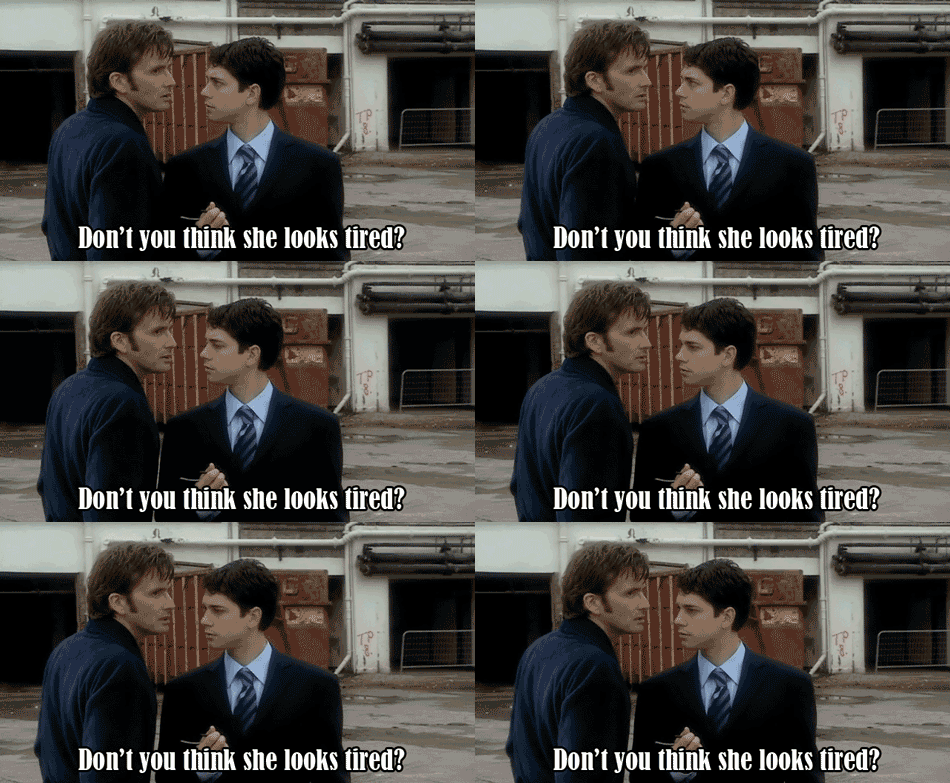
I know the quote is about what people thought of rebellion, that it is punishable and wrong the way that witchcraft is wrong. But what would be really cool is if rebellion really was a type of witchcraft, like for real. It reminds me of one of Doctor Who Christmas specials, the one where the tenth doctor says he could take down Prime Minister Harriet Jones with six words. He says to one of the people on her staff as if to plant a seed, "Don't you think she looks tired?" This of course, because the world feels her to be an unfit leader, leads to her downfall. It feels so witchcrafty to me:


After all, Harriet Jones had, only minutes earlier in the episode gone on TV and requested The Doctor come, and to people who don't know about The Doctor, they think she's just asking for a doctor. (Props to my husband Joe for offering that ingenious additional point, which totally blew my mind.) Anyway, the idea of planting a small seed that grows into something big feels just well, you know like, summoning with intention and all that magick-y Grant Morrison-ish stuff, like what LaVey meant when he said (pg 114, but actually taken from his book The Satanic Rituals, pg 25):


The idea of not knowing the actual science of what it means to put a hex on someone sounds a little like the "you have to believe in it to work" business you hear a lot from people who believe in that sort of thing. I want to believe in that stuff but I need some proof more than just making the proverbial fairy come back proverbially brighter if you say "I believe in fairies" over and over, you know like when the guy in Practical Magic goes, "Curses only have power when you believe them" (not to get too chick-flicky on a point here). But still, I like the quote anyway.

pg 15
I love the idea of myths evolving as civilization changes. The myth continues to be what it needs to be, ways of explaining the world (or defending aspects of it) but the meaning can change or something else can take on the original meaning. What once symbolized one thing can mean something else later. But there will always be ways of explaining why outcasts form their subcultures, and there will always be the leaders of the subculture hazing the newbies, who will then feel ostracized and go form their subculture to the subculture.

And there will always be the poseurs putting on their Baphomets and going to the nearest Denny's.

Wednesday, December 16, 2015

On Anger Is An Energy: My Life Uncensored by John Lydon


I enjoyed P.I.L./Sex Pistols front man John Lydon's second memoir Anger Is An Energy: My Life Uncensored, but boy, does he need an editor. There's this hilarious statement in the front of the book from the publisher that pretty much gave a warning that John refused to let us edit him, and yeah yeah yeah, we know sometimes it sounds janky but he refused to budge and so on. Sure, this book isn't going to win a Pulitzer, but it is definitely entertaining. I will say it sounds kind of weird when he talks about himself in the third person, like he's saying what other people saying about him "Johnny this, Johnny that" and it sounds a little bit like Bob Dole or Rickey Henderson. But anyway, in spite of the fact that he needed some more eyes on this, I still found it very interesting. Three particular quotes stand out:

page 213: "Education is not necessarily what the schools teach you. It's about acquiring the way of having an insight, and being able to gather information correctly."

Amen! It's about learning how to think. I'd add in learning how to think you're learning how to problem solve.

page 297: "I'm a nurse by nature, and I'm nursing you into the future."

Amen also! That's what really good artists do. And I suppose, good magazines, lit journals, blogs, anthologies, music sites or or any sort of THING that presents new things that we haven't encountered.

And finally, on page 427, he talks about the arguments he gets into with his wife, and this one struck me as preposterous, but I sort of loved it. He's referring to his relationship with her and how when you love someone but argue you can do it with love...or something.: "When you really love someone, you can practice hate in an enjoyable kind of a way!"

Is this what lots of celebrity memoirs sound like when they don't collab with a ghost writer? Occasional gems but mostly rambling? ...Because see how long it takes to get to the nub of the quotes I put above when they're put in the context of the actual full paragraphs they're from. They're entertaining but they read like a first draft:

page 213, the quote about education:

page 297, the quote about nursing into the future:

page 427, the quote about arguing with his wife:

OK, so maybe the quote about his wife actually makes more context of the full paragraph is sort of nice. 

But! He still needs an editor.

Or to do another draft.

A solid B effort with occasional polished gems of A moments.

Friday, December 4, 2015

On Be Here Now As Opposed to Being There Then


Recently I went back and reread Be Here Now (the book by Ram Dass, not the cocaine-fueled Oasis third album). Many years ago one of my brothers gave me his copy, and who the hell knows if I really got anything from it when I read it then. At the time I was young and dumb and probably thought Be Here Now was groovy in some sort of inexplicable way that jived with my amorphous, slightly new age-y, slightly agnostic, totally undefined flakey spiritual beliefs that changed depending on what book I was reading at the moment. P.S. Those "beliefs" have not changed much. That is to say, I don't really know what I believe exactly but whenever I read something convincing I'll pursue learning about that until I either a) lose interest of b) encounter something else that's phrased even more articulately and convincingly. Then that new thing will provide me guidance. This cycle goes on and on ad infinitum while simultaneously in the back of my mind I'm in a constant state of foreclosure on the whole spirituality bag at all. This is where the doubt sets in. Some of it depends on my mood, some of it depends on how much the music is swelling, and some of it depends on how shitty things are.

Anyway, even though there's a lot of "Hey-man-far-ouuuuut"ness to Be Here Now that feels cheesy, there are still some really insightful moments in it that speak to me in a way that didn't speak to me when I read this book when I was younger.

One thing that really stood out for me is the part where he talked about how when someone engages in a practice that of losing one's ego (by meditating or whatever), they get a certain energy from it because they're inspired by it. But where they go wrong is when they use that energy for accomplishing things that are still rooted in the world of ego, and then any progress one has made in losing their ego is lost. What would those things be? I have no idea. Bragging about how enlightened one is? Staying up all night on a caffeine bender and writing on their blog about how great they thought this book about meditating is? I don't know. But on an intuitive level I feel like I know what he means when he talks about using that energy keeps one on a "grosser plane" (pg 40):


Something else that really stuck with me was about how, no matter what your goals look like to others (or to yourself) everything that we do can be traced back to just wanting to get to some good. Maybe it's a perverse way of getting there, like doing bad to other people so that one can feel better, but the idea is to feel better (page 41):

And every desire, no matter how perverse it may seem, is an attempt to get to the light.  (The Devil knows not for whom he works.)

Yessssssss. I try to keep this in mind when I'm mad at somebody. I try to get to a point where I can remember that whatever it is that this person is doing, even if it's unreasonable, annoying, inconsiderate, condescending, shitty, stupid or downright evil, they're just trying to get to a place of comfort and light. And really, that's all anybody really wants; people just want to be comfortable. It's like a tired dad on a vacation yelling, "Shut up everybody! Can't I just sit here in this lawn chair for one god damn day and enjoy myself and be comfortable and relaxed?!" That's what our hearts want, just to be comfortable -- whatever comfortable is for us. Sure, comfortable can be relaxed, but it can also be stimulated, engaged or blissed out, or just sated or satisfied. What I'm not saying is that deep down people are good. What I'm saying is deep down people are just trying to move to a place of comfort and light. It's a subtle difference.

I also love this passage where he talks about having strong will is really just "your desire to get on with it" (pg 42):


Hell yeah, will power = one's desire just to "get on with it." That's kind of how I feel when I'm cleaning the cat box. It's like, I just want to have the thing done, and I just want to get started on it so I can be done with it, and that makes me want to do it. To just get on with the fucking thing. I guess that's what will power is.

But the other thing I like about this quote is the part about how if you don't have will power, just stay away from temptation. In other words, paraphrasing Weight Watchers, Don't bring the junk food in the house. Then you don't have to say no to it more than once.

And then finally, I love this poetic piece about love (pg 73):

Though the "vehicles differ from role to role, the essence -- the love -- is the same stuff.  In each instance what one is loving in the object of one's love is love itself ... the inner light in everyone and everything.

When we speak of falling in love, we might find that a slight restatement of the experience would help clarify our direction.  For when you say "I fell in love" with him or her you are saying that he or she was the key that unlocked your heart -- the place within yourself where you are love.  When the experience is mutual, you can see that the psychic chemistry of the situation allows both partners to "fall in love" or to "awake into love" or to "come into the Spirit."  Since love is a state of being -- and the Divine state at that -- the state to which we all yearn to return, we wish to possess love.  At best we can try to possess the key to our hearts -- our beloved -- but sooner or later we find that even that is impossible.  To possess the key is to lose it.

I love the part about falling in love is unlocking the place in your heart where we are love, though the "vehicles differ" of what you love, which I took to mean any person or cat or book or thing you love. The more I thought about love being a "divine state" as he calls it, the more I understand what he means. The feeling of the affection I feel for certain people in my life or my cat, really is exquisite, that there really is nothing like it. I wish I could carry it around with me all the time, say the way I feel when the cat is laying its head on me. It really is a feeling of love that is unlocked that I wish I could feel that way all the time, but it is easier said than done. I suppose that's probably what he meant by being here now.


Thursday, October 29, 2015

Dance Dance Party Party Workout Mix Tape #13 Download Halloween Edition Now Available

THE MIX TAPE IS COMING FROM INSIDE THE HOUSE!

My 13th mix tape now available for download from my website here. It's the Halloween edition! These are some jams I've been enjoying during workouts, and they are also the songs I used for tonight's Dance Dance Party Party session. Somehow I fit 21 songs in one hour. Part of the way I was able to fit that many songs in such a short span of time is because I edit out the boring parts of songs, especially if I'm trying to keep my heart rate up.

Sidenote: I got bluetooth headphones, and they have revolutionized my workouts. For one, no cords! For second, they sound so much better than the crappy earbuds you get free when you buy a device. Why did I wait so long to make the change? Well, money, honestly. They cost a sum that's a bit outside of my budget, but whatever keeps me working out, well, that's worth the money. So if you're listening to this mix on less than stellar headphones, sure, it'll be fine, but if you're running with music, it really helps to have some non-shitty headphones, if you're battling outdoor sounds. For me, the trick in considering new headphones is thinking about the fact that I'd be sweating on them, so I had to buy ones that were water resistant, or at least, ones that would be OK with a little bit of sweat. I got the Plantronics BackBeat Fit model, and they're totally worth the price. Also, I can't believe with all the sound editing stuff I do that I didn't get nicer headphones until now, and these totally do the trick.

OK, I've done my Consumer Reporting good deed for the day.

Thursday, October 22, 2015

Who's With Me?: I Totally Want to Go To a Haunted House Engineered by a Sociologist Who Studies Fear

Goddammit why am I up so early reading books about fear in my Hello Kitty pajamas?
'Tis the season for Halloween-esque reads, so I finished reading Scream: Chilling Adventures In the Science of Fear (PublicAffairs) by Margie Kerr. She's a sociologist prof but also works for ScareHouse, a haunted house in Pittsburgh. She also co-runs academic studies of fear. She went around the world researching fear in different contexts: roller coasters, places rumored to be haunted (like abandoned prisons), countries known for their high crime, a Japanese forest with a reputation for high suicide rates, etc. It's a fascinating read but also, it's a bit like the charmingly chatty and fun science writing of Mary Roach (who wrote books like Spook, Gulp, and so on). But it also has that personal journey feel to it to. So it's more than a sociological or scientific study. It's sort of memoir-y and sometimes kind of natural history-ish too.

Kerr gathered some very interesting cultural information about they way we process fear. For one, people who live in places that already have a high crime rate (like the city she went to in Columbia) have to deal with fear of existing in their everyday life which is already terrifying, so the country's artistic output doesn't include a lot of horror. Generally speaking, countries that are scary to live in don't have a lot of horror movies or horror film fests; they don't need it. But places that are safer to live in have much better horror movies. That is to say, the fear we associate with horror-inducing entertainment (haunted houses, horror movies etc.) is encouraged in places where generally speaking, we feel it is safer. That may be why America has so many haunted houses, horror film fests and "spooky" culture. You only "enjoy" roller coasters if you know it's safe to lie back and know in the back of your mind that you are not going to die (although your nervous system might disagree). It's as if you can only enjoy an experience you've paid to scare you if you know in the back of your head that it's safe.

Also, she learns that people enjoy terrifying experiences like horror movies, haunted houses, roller coasters or rappelling down from high places if they have someone to share it with, which is why you feel jazzed when you come out of the haunted house with your friends; you feel energized even though you were sort of terrified, and you're laughing but also sort of crying. It's that emotional release where all you want to do is talk to your friends about what you went through together. This was something the author put into practice at ScareHouse (specifically in the Basement, which is pretty much her haunted house lab where people sign waivers to let them be part of the study, and where Kerr puts into play what she learned about how we process fear). For example, one of the things they do is tie you up with your friend, but you're both holding hands, which biologically releases some kind of bonding endorphin, where you bond more with the person you're going through the terrifying experience with.

I thought it was kind of awesome in the book that she explained all the fear-inducing experiences she went through, and then took what she learned and put it into play to make the most terrifying haunted house ever, which unsurprisingly makes me totally want to go there and experience it. If I know that the haunted house I was about to go into was engineered by someone who does scientific and sociological (read: academic) studies for a living to make the place as terrifying as possible, I would be there in two seconds. Road trip anyone? How many hours drive is it from Chicago to Philly?(Sidenote: also, I see ScareHouse has a Krampus thing too!)

Without having seen it I can't say for sure but I have to imagine that the ScareHouse is probably better than a lot of the haunted houses I've  experienced, and although I love them all, I prefer a well thought out story line as compared to dinky ones at places like the Wisconsin Dells. (Additional sidenote: when I was a kid I feel like haunted houses didn't have story lines -- they were just like, boooooo scarrrry a haunted houssssssse. Now it's like there's a whole plotline when you go into haunted houses. I can totally get behind this. Like I have heard said, we enjoy stories because we are hard-wired for a narrative.) The haunted houses at the Dells are, like, run by one person, usually a high school kid working for minimum wage, who has to run around shaking shit at you. (A final sidenote: The past couple years the haunted house I went to around Halloween here in Chicago is the Fear City haunted house which is pretty awesome. It's a whole story line about Chicago after the apocalypse, and there's even a CTA train that looks and feels pretty real. It's off the hook.) This weekend I'm going to Elgin where they do up parts of the downtown as some kind of apocalyptic showcase showdown with overturned cop cars and zombies and whatever else. True, I find zombie stuff kind of boring (they move slow! they're stupid! etc. -- I know, I'm in the minority with the being-bored-by-zombies thing, but it really is sort of poetically, the sluggish cultural entertainment industry phenomenon that well, won't die.). But I do like the idea of a transformed city. Getting the outdoors involved in a haunted house is sort of awesome. It reminds me of the time I was at a haunted house in DeKalb, IL, and somehow I ended up at the front of the line where I accidentally led us outside (or so I thought it was accidental) and everybody was like, "What the hell, you just led us outside." But then a man with a chainsaw came running after us, and the whole thing was so disorienting that it was genius. My friend who was behind me said that the burly guy was so scared that he was cowering behind her. And she's like 5'2".

At the end of the book I enjoyed how Dr. Kerr hooks up to a machine that measures her brain waves and gives her some very enlightening information about how she herself processes fear. I totally want to do that. If I had a machine that studies my brain waves I would use it every second of the day during everything I do. I should add that to my Amazon Wish List. People! Want to buy me a gift? Get me an EEG machine for home use! Apparently they have them now. The "MUSE" they're called. I did read in like Vice or something where someone used one and when put on some setting where it's supposed to give you some kind of feedback on helping you relax (I don't know what the hell I'm talking about) that whenever they'd be about to relax that it would start beeping or something and going, "YOU'RE NOT RELAXING" or something ridiculous like that. So anybody who plans on buying me one of those, make sure to get me one that doesn't do that. Ok thanks!

Also accepted: key lime striped socks from Sock Dreams and Savor the Scen​ery Cont​ainer Set from ModC​loth
Addendum: The reason I started writing about books on my blog is because I said that I would post quotes I like from books in sixteenth century Commonplace Book style, so here is the quote I underlined in the book from a passage I particularly enjoyed:

"[A study documented in] The Handbook of Emotion Elicitation and Assessment...offers an explanation...basically when we do evolutionarily salient activities (things that activate fight or flight or that influence our survival) by ourselves we find them less rewarding. We have evolved to be together, especially in times of stress."

I can totally understand this. It reminds me of how when you perform with a group as an ensemble, you share in the sometimes nerve-racking experience that can be more rewarding when it goes well. It also makes sense that when you bomb in a group performance, it's easier to get over when you all share the blame. Ha!

Wednesday, October 7, 2015

I Collaborated with Britney Spears & Iron Maiden But They Didn't Know it


I made a mashup of Britney Spears and Iron Maiden you can listen to on my Soundcloud site. I'm calling it Criminal Number Beast Running To the Hills (Britney Spears vs Iron Maiden). It's totally preposterous and kind of janky but I chuckled the whole time I was working on it. You can stream it or download it and you know, have nightmares to it.

Hilariously, I thought about adding Bruce Dickinson's rant where he mentions "Britney fucking Spears" in a live performance in Rio but then decided not to, because I thought maybe it would come across as angrier than I wanted it to sound, so you know, I ditched that idea.

Also, the graphic is from a t-shirt on 313merch.com.

Thursday, October 1, 2015

New Episode of Found *NSYNC Fan Fiction


A new episode is up of the podcast I do with my friend Sacha called Found *NSYNC Fan Fiction, where we chronologically read aloud pages of one author's *NSYNC fan fiction, from a binder found at a thrift store in Chicago. We have not read ahead, so you're experiencing each page with us IN REAL TIME.

You can listen to it here on our podbean site, or here on i-Tunes.

In this episode, we learn shocking news that threatens to change the lives of Joey, the narrator, and the narrator's family at home during the*NSYNC tour, which brings the tension between them to a head. Alyson Hannigan makes a cameo (as in Willow from Buffy), as do Joey's parents. We drink ten year old Limoncello while Sacha accompanies the reading on a Casio keyboard, which somehow magically evolves the podcast into a radio soap opera. As usual, there's plenty of weird accents, snickering and snarky asides, while we try to just, really, hold it together without losing our shit entirely. I suggest listening to this episode on headphones so you can hear the piano better. And hey! It's free!

We ask: WHO KNOWS? THE JOEY FATONE KNOWS!

Friday, September 25, 2015

Loving to Make Fun of Things We Love


A few years a go I turned 40. When it came time for me to decide what I wanted to do for my birthday, I thought about what my favorite activity is, what I really I enjoy doing that I could share with other people, was that I really enjoy sitting around with like-minded friends who have a similar sense of humor and experiencing media that we can make fun of. It could be movies, it could be music, or it could be TV. So that's what I did. My husband said, "I see you looking wistfully at those quinceanera dresses in the windows of those shops on Western Avenue. I will buy you a beautiful princessy cake-layered quinceanera dress for your birthday, and you can have a party." This, of course, because I have the fashion sensibility of a sixteen year old girl. Once we saw that those dresses are thousands of dollars, I told him not to buy me a dress. Instead, I said I would just wear my wedding dress, because it was pretty princess-y. I told everybody to come over and watch ridiculous found footage curated by a friend who collects this sort of thing while we ate snacks and I wore my wedding dress. So I turned 40 and all I did was sit around and eat snacks and make snarky comments with my friends because I think  that may be one of my favorite activities.

It is also true that I like making fun of things I like. Jerry Seinfeld (or maybe it was Jeff Garlin) said in an interview with Judd Apatow in his book Sick in the Head: Conversations About Life and Comedy (don't ask me what page, when I finish reading it maybe I'll write about it), something to the effect that good comedians make fun of things that they like. I can understand this. I may love something but can also see the preposterousness in it, which is why I understand when people make fun of music I like. I definitely feel like we are capable of seeing multiple sides of something, both loving things and why somebody would make fun of it. One of my friends was recently wearing a Whitesnake t-shirt, and asked her "Are you wearing that shirt because you like them or you're being serious?" She answered the perfect answer (which is probably why we're friends): "Both. I am a fan, and I stole this t-shirt from my brother, but I mean, come on." Clearly this is someone who can both enjoy something but see it for it's preposterousness, which I can totally understand (especially in reference to Whitesnake; I have done Here I Go Again at karaoke multiple times).

I remember making a mix tape for a friend in college and she sent me a letter back itemizing hilarious comments about each of the songs. I loved each song on the tape (which is why I selected those songs) but her commentary making fun of each song was so hilarious -- I could simultaneously understand why she said those comments and enjoy the music at the same time. It also proved to me that she actually listened to the tape, so that made me appreciate her comments all the more.

I wrote the zine The Bad Lyrics Project that listing some of my favorite bad lyrics, but I will be the first to say that a lot of the lyrics I mentioned in the zine come from songs that I do actually like. In fact, the reason I stumbled on many of the lyrics was because of my familiarity with the songs because I listened to many of them with some amount of frequency.

This is all why I loved The Worst Rock n' Roll Records of All Time: A Fan's Guide to the Stuff You Love to Hate by Jimmy Guterman and Owen O'Donnell (Citadel Press). This book appeals to the same part of my brain that generated the Bad Lyrics Project. And I feel like it would be an awesome college class to teach: Music to Make Fun of 101, and companion volumes for required reading in the class would include Kill Your Idols: A New Generation of Rock Writers Reconsiders the Classics or maybe Chunklet magazine issues #18 and #19, The Overrated Issues Parts I and II.

I chuckled aloud at parts of this book and marveled at how they articulated things that I always intuitively felt but never had words for. When my husband suggested I read this book, he said,"This book reaffirms how you feel about particular songs," which gave me a nice feeling of recognition and a kind of vindication. There were moments reading this book that I was like, "Holy shit. I could have written that. Not as articulately or as hilariously, but that sentiment, that is totally how I feel about that song and is EXACTLY my style of humor." It's kind of weird when I run into writing that strikes me that way, which doesn't happen very often but when it does it feels really special. When I read this book I thought There's a version of me out there as manifested by these two other music writers who are like, my energy or something, but with way better writing skills. Or something. Like me. But better.

Without getting into the specifics of what artists and songs they talk about in the book, suffice it say that I love that devote some space to some of the music I grew up with when MTV first went on the air when I was a kid (although the book isn't limited to that).

But I will however, list my favorite quote, on pg 116. It's actually in reference to a particular album, but it totally stands on its own point, in reference to performers in many different fields:

Why does nearly every rock and roller we trust let us down sooner or later?...Is it that we hold impossibly high expectations for performers to maintain over the long run, or is rock and roll truly the domain of the young and hungry? At the very least, there is a propensity for performers to start choking on their own fumes once the become rich and famous.

I particularly like that bit about propensity for performers to start choking on their own fumes. It's like a version of believing your own press, or becoming so successful in terms of making money that you are then unable to recognize when your music sounds good anymore because your idea of success has changed. I think intuitively we all know that the "fume choking" happens around the time you go from doing work about the universal struggles in life to struggles with fame. When the switch happens, nobody takes you seriously anymore -- the moment you start with the "why can't you people just leave me alone?" business the public is done with you.

Is rock and roll the domain of the young and hungry? Maybe. I'll have to think about it some more while I sit here eating Funyons in my wedding dress.

Friday, September 18, 2015

Dance Party Workout Mix Tape #12 Download Link

Ye me encanta bailar: I love to dance
I made another dance mix tape for you to download as one track. Here it is on my website. It starts and ends with warm up and slow down songs. The last fast song is started with an airhorn to signal it is the last fast song. I find these mixes to be not just good for dancing but also for cleaning, running and commuting. And here's a blog post I wrote about it for Dance Dance Party Party on the DDPP blog. I DJ under the name MC Escher.

Enjoy!

Thursday, August 20, 2015

Class Authenticity, The Rain In Spain & Sooonshiiiiiiine: On Alex Niven's Oasis' Definitely Maybe 33 1/3 Book

My cat hates it when I read because I'm not paying attention to him.
I feel bashful when I share with people that I like Oasis. One time at work I requested a desk copy from a book distributor of the original Oasis drummer's memoir (Oasis: The Truth: My Life as Oasis's Drummer by Tony McCarroll), and when it arrived, one of my co-workers opened the package and pulled it out and pinching it like it was contaminated underwear, he said, "Should I grab bag this?" I said, "Actually, I requested that book." I had to come clean; I thought I would have intercepted the package but he got to it before I did.

I've on the sly been reading books about Oasis and special Oasis-centered editions of Mojo and Uncut for years, and the only person that knows this is my husband, who makes fun of me. If Oasis ever comes up in conversation, he starts singing the refrain from My Fair Lady "The rain in Spain falls mainly on the plain," which I agree, does actually does sound like a line that would be in an Oasis song.

Has anybody done a mashup of Oasis and My Fair Lady? Because I can't possibly be the first person to make the connection of the working class Brit elevating their status by way of some sort of performance (a lower class Eliza Doolittle learning/performing the mannerisms of the upper class, the Gallagher brothers elevating their status from working class to British nouveau riche by creating/performing music etc etc etc bla bla bla).

when there's no sooonshiiiiiiine
And that's where Alex Niven's 33 1/3 book about Oasis' first album Definitely Maybe comes in. But I'll get to that in a minute.

My relationship with Oasis is a carryover from a previous boyfriend of many years ago who got me into them. Previous to him, I had always kind of found them boring. However, when someone can act as a tour guide for a band and expose you to the right songs with the right introductory explanation, that's where the appreciation can come in. You would think after the relationship ended I would not want to have listened to a band that my ex was into, but amazingly, the amount of time I had to lay off Oasis was relatively short, and then Oasis was reintegrated into my heavy rotation. And in fact, even though at that point I'd only had the first two Oasis albums and a variety of other B sides, it was actually the boyfriend after him (now my husband), who gifted me the third Oasis album, Be Here Now. That third album is the one that Noel Gallagher told Chuck Klosterman in a 2011 interview on grantland.com that during the recording "We were taking all the cocaine we could possibly find," which explains its less than stellar success.

Oasis' first two albums (Definitely Maybe and (What's the Story) Morning Glory?) are solid. Although there are a fair number of songs from later Oasis albums that I do like quite a bit, somehow there weren't any Oasis albums that captured the anthemic energy of those two albums. The more recent work made by the Gallagher brothers, independent of each other after the breakup of Oasis, lacks the synergistic awesomeness that happens when they were in a band together.

Sidetone: I saw some hilarious press conference with Noel Gallagher (the elder brother and primary song writer for Oasis) when Oasis broke up. I could have sworn that he described this one event that preceded the breakup of the band. Liam (the younger brother and the one with the iconic Oasis snarly whine that people tend to equate with the band) asked Noel if the Oasis tourbook for the next tour could feature his clothing line Pretty Green. Noel said no, which made Liam so angry he smashed a guitar. His own guitar. This is, of course, hilarious to me.

Independent of each other, the Gallagher brothers pursued their own bands. Noel Gallagher's High Flying Birds have a few good songs and Liam Gallagher's now defunct band Beady Eye had a few good songs, but both projects were missing the ingredients that the other brother puts in it. Noel's band is missing Liam's Mancunian drawly sneering sass, and Liam's band is missing Noel's songwriting input. At this very moment I'm listening to the High Flying Birds album "Chasing Yesterday" on Spotify and maybe it's because it's 12:42am on a Wednesday, but I'm hardly feeling moved to do air guitar moves. Is that a saxophone? Is that why Liam Tweeted on May 7th of this year, "Just coz you have a SAXAPHONE on your new record and you think your all Pink Floyd LG x"? Because that's about when this album dropped. I should also add that Liam then Tweeted "Everybody knows your just another PRICK in the wall LG x" which in spite of the spelling error, is actually pretty funny.

So, both brothers are aging, estranged from each other beyond just their notorious constant bickering, making music that isn't quite as awesome as they once did when they were together in the 90s, ruling British music with anthemic rock. Something about it is sad to me.

Oasis very much appeals to the part of me that loves anthemic guitar-driven rock music, which I refer to as the Guitar Center part of my personality. I do love me a good anthemic rock song.

Now would be a good time to mention that the ex-boyfriend who got me into Oasis also gave me a bunch of the guitar tablature for Oasis songs that I liked. After much practice I could fake my way through a few of them, but never in a way that wasn't ridiculously embarrassing, accompanied by a lot pausing and me going, "Wait! Wait!" while switching cords. Mostly what I remember though is that Wonder Wall requires a capo (this, because the Oasis Tour Guide boyfriend showed me), that Noel Gallagher writes a lot of music with alternating D and D sus chords, and that Cast No Shadow was sort of easy to play.

After reading Alex Niven's book: Oasis' Definitely Maybe book, from the 33 1/3 series (Bloomsbury), I had half a mind to pull the guitar back out and give some Oasis songs another go (although the aforementioned songs are actually on Morning Glory), but come on. Honestly, NoWaysis. The most that I'm willing to do is listen to Oasis in the car. P.S. Wonder Wall is actually one of the more boring Oasis songs. No wonder everybody thinks Oasis is boring. They're better when they're doing arena rock. Also, NOBODY wants to hear me snarl whine my way through Oasis at karaoke. "But we really want to watch a short Jewess from northshore Chicago perform Rock'n'Roll Star at the American Legion Hall" said ABSOLUTELY NO ONE.

That is, except for my husband. He did tell me that he thought my Cigarettes and Alcohol rendition was pretty rocking. So I guess that's a thing. I did get a karaoke disc with a bunch of Oasis songs but it's shitty and low quality, and the lyric graphics are all janky and get jumbled on the screen. Boooooo.

So as a semi-closeted Oasis fan, I enjoyed Niven's book. For one, he defends accusations of Oasis making simple and derivative music, and the difference between pastiche and plagiarism (and how depending on the musician's class, the same act can unfairly be considered one or the other), and how class plays into the Oasis narrative. I found the book to be thoughtful and worded so articulately that if there was anybody sitting next to me I would have read them the passages I was putting stars next to.

In the foreward Niven writes, "It was also important to me to try to show that even the most simplest-seeming pop music can contain multitudes of meaning." I couldn't agree more. We all know that as an audience member, the meaning we derive from a song may not actually be in the songwriter's intent. Sometimes meaning can be derived from considering the song through a lens unintended by the writer and performer. We might use a historical lens, a sociological lens, or a critical lens used by those who consider pop an artform worthy of intellectual digestion. I've always thought that no matter what the topic, there is always something intelligent to be said about it. It may require some processing, or if it's about some work of art what you come up with may not be compatible with what the creator intended, or it may even be cynical and snarky, but the potential is there for thoughtfulness on any topic. Hence, any pop song "can contain multitudes of meaning," as Niven writes.

I also loved Niven's point defending Oasis' musical output as being a creatively successful work that is more than just simplistic stealing on page 25:

"When middle-class musicians resort to appropriation and collage it is often applauded as 'allusion' or 'pastiche', when working-class musicians do it they are dismissed as plagiarists, or prosecuted as outright thieves. The notion - still popular in some quarters - that Oasis were chancers who rose above their station by stealing other bands' creative property is patronizing and ultimately untenable. Whatever can be said about their musical conservatism in later years, on Definitely Maybe, Oasis's appropriation of the past was just as valid, and just as creatively successful, as the sample tapestries on Public Enemy's It Takes a Nation of Millions."

Amen.

At the beginning of the book, Niven included a lengthy Dostoevsky quote from The Brothers Karamazov, about being rejected by the unforgiving world, but then watering the earth with one's tears that then bring forth fruit. It's making art from one's grief. It's a fitting quote for the story of a band confined by the limits of their membership to dead end working class, but making art inspired by dreams of escaping their station, which Niven posits is a large part of the Oasis narrative.

I love the image of the Gallagher brothers (and the rest of the band) against the world that looks down on them (even though everyone knows they never really got along). So the idea of the band being years past the prime of their success of the first two albums (not to mention broken up) creates a weirdly poetic wistfulness in me, especially considering I wasn't even all that into them until after their first two albums had already peaked. And before you jump in and go "Well maybe you're being wistful for the relationship with the Oasis tour guide boyfriend" I feel it important to say that I was really unhappy in that relationship because it was a really unhappy time in my life.

What I want to say is that the wistfulness comes from the part of my personality that gets really caught up in other people's narratives, especially performers' story arcs, like for example Britney's rise and fall and rise again (but as her current Zombney the Undead state where she's been replaced by an automaton, managed by other people).

But the truth is that I think the wistfulness comes from the part of my psyche that fears the decay of getting old, past one's prime, sick, or even worse, what happens when all your dreams come true and then you're not left with anything to look forward to (which is why I think some celebrities turn to religion in their "YES BUT WHAT DOES IT ALL MEAN?!!" moments). The Gallagher brothers and their fellow Oasisians are hardly decaying and I'm happier as I get older, but it's probably true that there's my fear of death in there somewhere. Queue up the Andrew Lloyd Webber music to accompany the one-time glamour feline singing about her days in the sun, unsuccessfully copying dance moves of the younger cats, but alone and frail, unable to capture the magic of the Ball. And so on.

Niven writes about Oasis that they were confined as "losers in a failing city" then escaped their economic and social status by becoming rock stars. He describes it excellently on page 18:

"In 'Rock'n'Roll Star', Noel Gallagher's alternative plan was to get a car and drive it as far as he could away from Manchester, a plan that was ambitious given that he had no money and had never learned to drive."

Ah yes, even part of the class you might not even have the background to exist within it once your there. How very Eliza Doolittle.

A band is on top of the world, then they get bloated and it all falls apart. I will always be pulled into the rock and roll narrative. After all, the rise and fall is the greatest story ever told. Of course it's better if the narrative denouements out with a rise again, but the climb back to the top is often pretty artificial. We all age, we all die, or at least we all have to live in the real world where it isn't always the high of being on top again: grocery shopping, daily living, paying bills, trimming your toenails -- life is not just one big montage of being on top all the time. Sometimes it's boring.

All this is to say that the real problem with the rock and roll narrative is that often it's a rise and fall that may or may not have a rise again, but if it does have a rise again, the rise never recaptures the magic and vitality of the first initial rise. This makes sense to me. For one, everyone loves an origin story and sequels are never as good as the origin stories, the Oasis origin story being one of a working class band becoming extremely successful such that for Brits, being a soccer hooligan became cool, (as opposed to the art school snobbiness of a band like Blur, the sort of anti-Oasis). But more to the point, the narrative does not account for people getting older or ending the band. Nobody wants to watch rock stars age.

Niven sums it up best on page 20:

"After Oasis really became famous, after they finally, decisively escaped from Manchester, the strength of their idea that pop music can allow anybody to achieve empowerment in a moment of liberation would be undermined by the boring reality of their status as lofty celebrities. When you are actually a rock star, singing about the fact to crowds of thousands every night is not a statement of idealism. It's a description of a daily work routine."

Ah, the bloating. It's as if to say their narrative went from underdog to the overweight dog of the status quo. In the documentary Live Forever: The Rise and Fall of Brit Pop, Louise Wener, former lead singer of the Britpop band Sleeper, talks about Noel getting invited to Downing Street to see Tony Blair. She said of Noel's visit how "Everything he was about, he used to not "belong" to anybody, and then suddenly he did, he was right in their pocket, and in that very instant, he was neutered, like someone had just come in with a knife and cut his bullocks off."

If there was the Oasis biopic (there seemed to be some discussion around 2011, but it seemed like it never really panned out), that visit would be the moment where it's clear the band went from being the band that united the classes, their music played ubiquitously in bars, discos, weddings, just, everywhere in Britain with anthemic "We're in this togetherness," to a sort of resented and resentful cynical parody of themselves. "Cynicism is the patois of the status quo," Niven writes on the first page of his book, as if to remind us that the rock and roll rise and fall ends in the band leaving youthful earnest rebellion behind and turning to jaded cynicism.

I loved Niven's discussion of Britpop. In this quote, he's referring the the song Shakermaker, which ripped off part of the I'd Like to Buy a World a Coke jingle, which well, Coke is pretty much a symbol of consumerism. Oasis was considered to be the more sort of authentic, less middle class alterna contemporaries Blur, Suede and Elastica. I enjoy the overview laid out so articulately here, with a little help from critic Jon Savage as well, on page 27:

page 27. Thanks, Google Books!
The sentiment about Britpop being composed of ill-informed bougie bands singing about working class is the classic "You're a suburban poseur, why are you complaining about gentrification in your city block?!" argument. I don't know if it's really warranted because I'm sure it's more complicated than that. And to be fair, I do like Blur, Suede and Elastica. But I do like the quote's overview of the different bands within Britpop and what they each tended to symbolize, the implication being that Oasis represented an authentic honest working class while wanting to be the upper class, while many other bands in Britpop merely wanted to criticize the middle and upper class, attempting to identify with the lower class.

I never thought I would say this but I think I just wrote a piece on how the career trajectory of Oasis symbolizes death. This wasn't quite what I envisioned in discussing a band that appeals to my interest in anthemic rock which is usually celebratory, but I suppose any story with a linear arc only goes in a single direction, forwards, and nothing lasts forever. Well, as long as you don't have to listen to me play any of these songs on the guitar it'll be fine.